
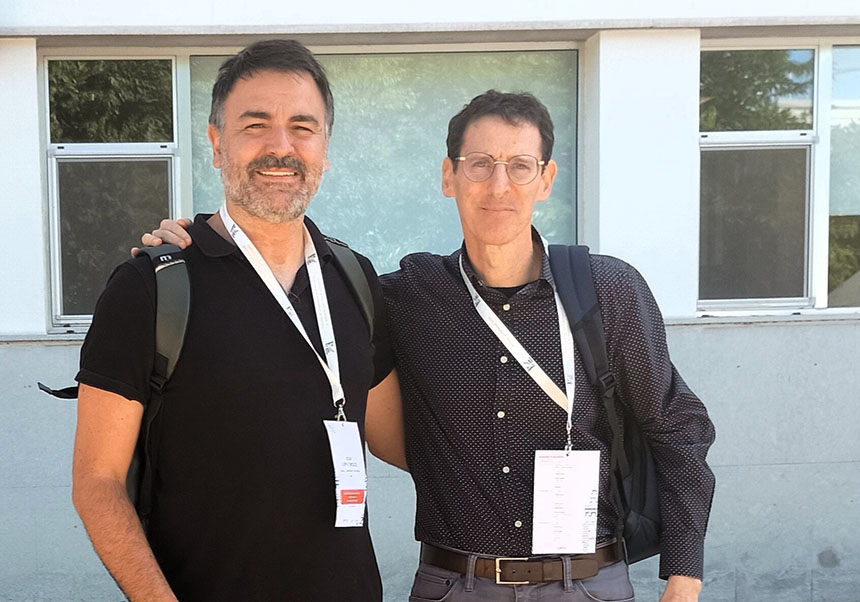
A recent study led by INGENIO (CSIC-UPV) and Universitat de València reveals that researchers who are motivated by the desire to benefit society collaborate more intensively with companies, public administrations and civil society organisations. The study, published in Industry and Innovation by Oscar Llopis (INN4ALL, Universitat de València) and Pablo D’Este (INGENIO, CSIC-UPV), analyses responses from more than 10,000 researchers working in Spanish universities and public research organisations across a wide range of disciplines.
The research aims to explore what drives scientists to move beyond the laboratory and engage with companies, hospitals and community organisations. To do so, it distinguishes between three main motivations for conducting research: intrinsic motivation (the intellectual satisfaction of solving problems), extrinsic motivation (recognition and career advancement), and prosocial motivation (the desire for research to benefit society).
The findings reveal “key factors for bringing science closer to society,” explains Oscar Llopis. In particular, the study shows that prosocial motivation is positively associated with collaborative research involving societal actors. By contrast, researchers primarily driven by personal satisfaction or academic recognition tend to collaborate less, often perceiving such partnerships as a constraint on their autonomy or as a distraction from the scientific productivity rewarded by the academic system.
The authors also highlight that “this prosocial spark translates into collaboration mainly when researchers possess strong networking skills.” This implies a greater ability to connect different communities, identify collaboration opportunities and communicate research beyond academic circles. While the desire to help society is important, the ability to build relationships is what turns that motivation into effective collaboration. “Wanting to contribute to society is not enough; researchers must also know how to build the networks that make such collaboration possible,” add Oscar Llopis and Pablo D’Este.
Another notable finding is that researchers with strong prosocial motivation do not limit themselves to a single type of partner. Instead, they collaborate extensively with both companies and civil society organisations. This suggests that a sense of social purpose can act as a bridge between very different institutional worlds.
The results indicate that fostering a sense of social purpose and providing training in networking skills could be an effective strategy for universities and research centres seeking to strengthen interactions between science and society.
The study was carried out within the framework of project PID2022-137124OA-I00, funded by MICIU/AEI/10.13039/501100011033 and the European Regional Development Fund (ERDF, EU). It also received support from the EXTRA project (CSO2013-48053-R), funded by the Spanish Ministry of Economy, Industry and Competitiveness.
Reference: Llopis, O., D’Este, P. (2026). “Does scientists’ prosocial fire fuel research collaborations with external partners? The role of research motivations and networking skills”. Taylor & Francis. https://doi.org/10.1080/13662716.2026.2662859









'/%3E%3C/svg%3E)
'/%3E%3Cpath%20fill='%23b2b2b2'%20d='M241%20382q0%2016%2017%2026%2017%2011%2042%2011t42-11q16-11%2017-26V269H241'/%3E%3Cpath%20fill='%239f7e00'%20d='M241%20379q0%2014%208%2023%209%209%2021%209%2014%200%2021-9%209-9%209-23V269h-59'/%3E%3Cpath%20d='M241%20339v-70h59v110q0%2014-9%2023l-6%205v-68h-15v72q-8%200-14-4v-68zm59%2040c0%2022%2015%2032%2029%2032%2021%200%2030-18%2030-32v-40h-59'/%3E%3Cpath%20fill='%239f7e00'%20d='M266%20277v5h2v12h-3v-5h2v-5h-9v5h2v5h-4v9h3v18h-5v10h34v-10h-5v-18h3v-9h-4v-5h2v-5h-9v5h2v5h-3v-12h2v-5zm42%20101q0%2010%206%2017%206%206%2015%207%2010-1%2016-7%206-7%206-17v-29h-43'/%3E%3Ccircle%20fill='%230044ad'%20cx='329.5'%20cy='372'%20r='6'/%3E%3Cellipse%20fill='%230044ad'%20cx='300'%20cy='340'%20rx='16'%20ry='21'/%3E%3C/svg%3E)