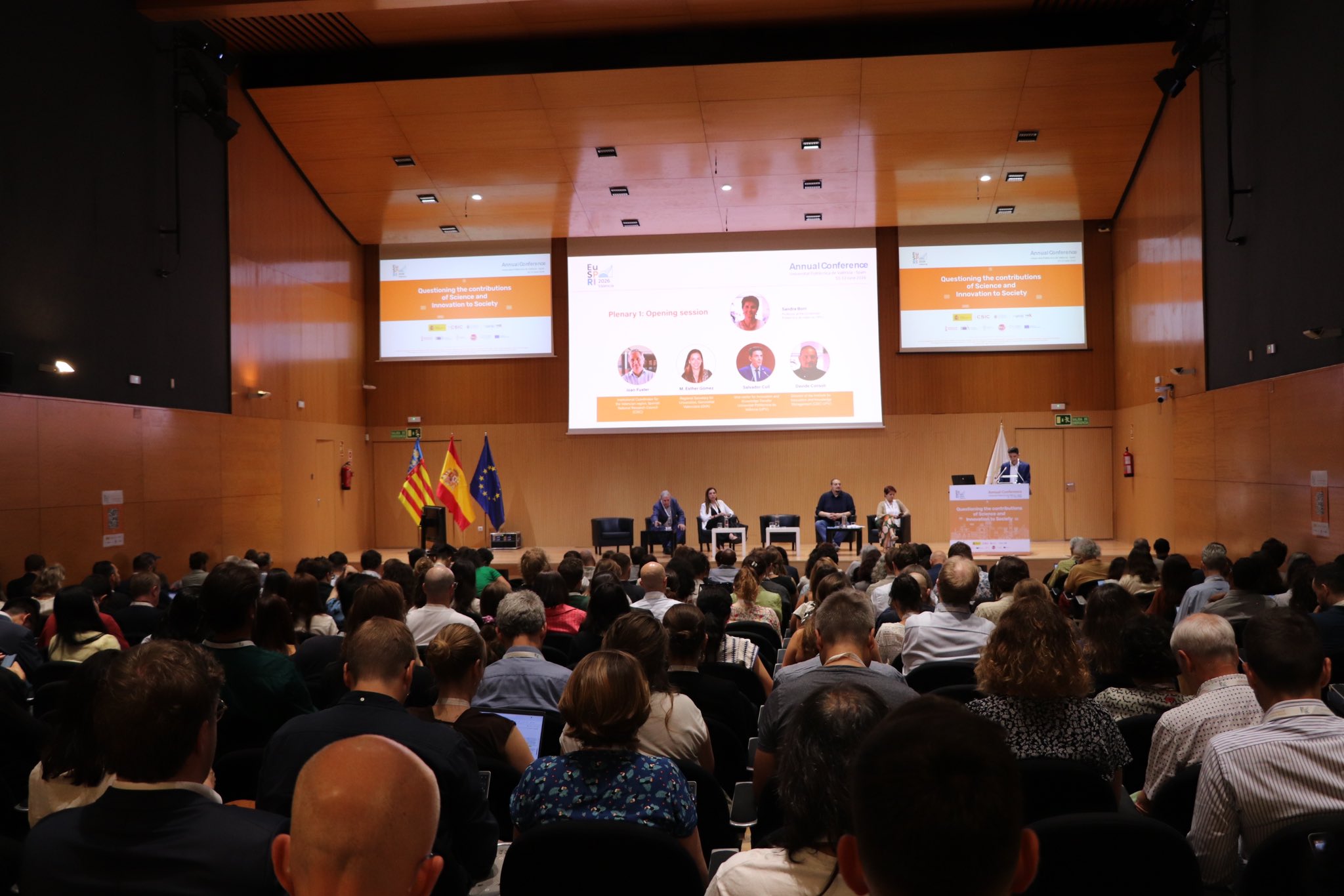
The annual Eu-SPRI 2026 conference, organised by INGENIO (CSIC-UPV), will bring together nearly 470 participants from Europe, the Americas and Asia at the Universitat Politècnica de València from 10 to 12 June.
Valencia will host the annual conference of the European Forum for Studies of Policies for Research and Innovation (Eu-SPRI) from 10 to 12 June, one of Europe’s leading events for the analysis of science, technology and innovation policy. This year’s conference is organised by INGENIO, a joint research centre of the Spanish National Research Council (CSIC) and the Universitat Politècnica de València (UPV), and will take place on UPV’s Vera campus under the theme Questioning the Contributions of Science and Innovation to Society.
The conference will bring together nearly 470 participants, mainly from Europe but also from the Americas and Asia. Attendees include researchers, representatives of public research organisations, national and local administrations, public agencies, the private sector, the European Commission and the OECD. Over the course of three days, around 375 scientific papers will be presented in parallel sessions, alongside 14 special sessions and seven plenary sessions, including three keynote lectures and four panel discussions.
Rethinking the role of science and innovation
The programme for this year’s edition encourages critical reflection on the contributions of science and innovation to society, as well as on the challenges arising from scientific and technological progress. “Science and innovation have driven major advances in social welfare and quality of life, but they have also generated new problems and unintended consequences that require critical examination,” explains Sandra Boni, researcher at INGENIO and co-chair of the conference organising committee.
The event will address the challenges associated with the rapid pace of technological change and scientific advances, as well as the need to develop new ways of supporting, organising and applying knowledge. In this context, the plenary sessions will focus on some of the most pressing issues facing contemporary societies, including global environmental change, the capacity of research and innovation to respond to societal needs, the risks and unintended consequences of innovation, and the economic and social transformations linked to these processes.
The scientific programme also includes parallel sessions devoted to some of the most relevant debates in science, technology and innovation policy. Topics will include the integration of artificial intelligence into research and public policy design, as well as the governance of scientific and technological organisations. Other sessions will explore the role of responsible research and innovation in health and the use of public procurement as a tool for driving transformative change, among other issues.
New ways of collaborating to tackle complex challenges
One of the conference’s central messages is that the complexity of today’s social, technological and environmental changes requires new public policy approaches. “These challenges call for more sophisticated forms of collaboration between public and private actors, as well as new institutions, regulations and practices capable of steering that cooperation towards socially desirable goals,” says Jordi Molas, researcher at INGENIO and co-chair of the conference organising committee.
With this edition, Eu-SPRI 2026 aims to provide an international forum for reflection on how science and innovation can help address major contemporary challenges, while continuing to critically examine their limitations, risks and societal impacts.
The origins of Eu-SPRI
Eu-SPRI was founded in 2010 with the aim of bringing together a research community that had previously been dispersed across a range of disciplines, including economics, political science, sociology, science and technology studies, business administration, geography, history, philosophy and ethics. Today, the forum comprises 19 full members, consisting of research units and organisations based at universities and public research institutions.
Each year, one member organisation takes responsibility for hosting the annual conference, from defining the central theme to designing the scientific programme and accompanying activities. In 2026, INGENIO (CSIC-UPV) serves as the host institution, reinforcing Valencia’s role as a key venue for international debate on science, innovation and society.